

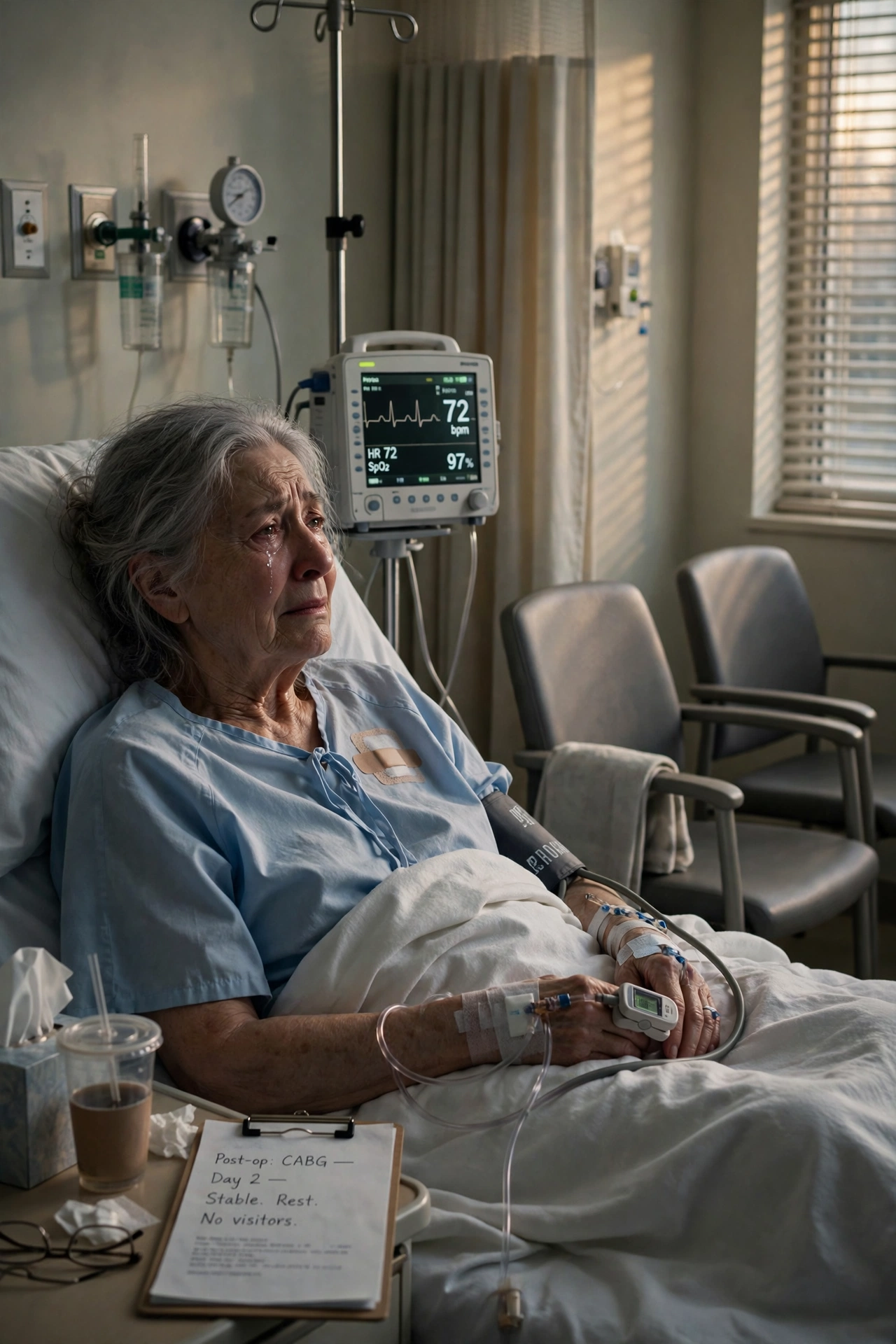
“Adrienne, your children didn’t go home because parking was expensive.”
Malcolm’s words hung in the air between us. My heart monitor began to beep faster.
“Then why?” I whispered. “Why did they leave me?”
He slid the paper across my blanket so I could finally read the sentence he had highlighted in yellow. It was from a law firm. And the sentence said:
“Petition for emergency guardianship to be filed on the day of the procedure, while the patient is under anesthesia and unable to object.”
I read it three times before the words made sense.
“Guardianship?” My voice shook. “For who?”
“For you, Adrienne.”
Malcolm explained everything, gently, one piece at a time. While I was being wheeled into heart surgery, my three children had not gone home at all. They had gone across town, together, to a lawyer’s office.
David, whose accounting firm was quietly drowning in debt. Sarah, whose credit cards I had been paying off for almost two years. Michael, who had already asked what my house might be worth “when the time comes.”
They had prepared papers that would give them control of my bank accounts, my pension, and my house — the little house where I had raised them. Parking was never the reason. Parking was just the story they gave the nurse, because the truth was too ugly to say out loud.
“I don’t want to see them,” I cried.
Malcolm held my hand a little tighter. “You don’t have to face them alone. That’s why I came today.”
What I didn’t know was that Malcolm had already made three phone calls before he ever walked into my room: to the lawyer’s office, warning them the petition would be contested immediately; to his own attorney, one of the best elder-law attorneys in Seattle; and to the hospital, with one instruction — nobody was to discuss my finances or my legal status with anyone but me.
That evening, my children came back. Sarah was carrying the flowers she had promised me. David walked in first — and stopped dead when he saw Malcolm sitting beside my bed, the manila folder open on his lap.
“Who are you?” David asked.
Malcolm stood up slowly. He didn’t raise his voice once.
“I’m the boy your mother fed,” he said. “Every single day, when I had nothing. She spent half of what she earned so a child who wasn’t hers wouldn’t go hungry or feel ashamed.”
He placed the lawyer’s letter on the foot of my bed, where all three of them could see the highlighted sentence.
“She gave when she had almost nothing. And today, while she was under anesthesia, the three of you tried to take everything she has left.”
Sarah’s flowers slipped lower in her arms. Michael couldn’t look at me.
“We thought you might not wake up,” Sarah sobbed at last. “And then we panicked. And one thing led to another, and it just… got out of hand.”
“You were wrong about one thing,” I told them. “I did wake up.”
That night, no papers were signed.
In the weeks that followed, Malcolm’s attorney unwound everything my children had started. My accounts were protected. My house stayed mine. And I made a decision of my own — freely, with a clear head.
When I am gone, my house will be sold, and the money will go to Malcolm’s foundation — the one that makes sure no child in our city’s schools ever sits hungry in a cafeteria again, watching other children eat.
My children were furious at first. Then ashamed. Then, slowly, they began to show up — not with lawyers, but with soup, with flowers, with time. Forgiveness is not a door you open all at once. It is a corridor you walk down, one honest day at a time. We are still walking it.
And the last thing Malcolm said to me before I left the hospital was this:
“Mrs. Davis, fifty years ago you handed me a lunch voucher and told me somebody should make use of it. Today, everything I built with my life got its use.”
Kindness is never wasted. Sometimes it just takes fifty years to come home.
— END OF PART 2 —
If this story touched your heart, share it with someone who still believes that one small act of kindness can change a life forever. ❤️