

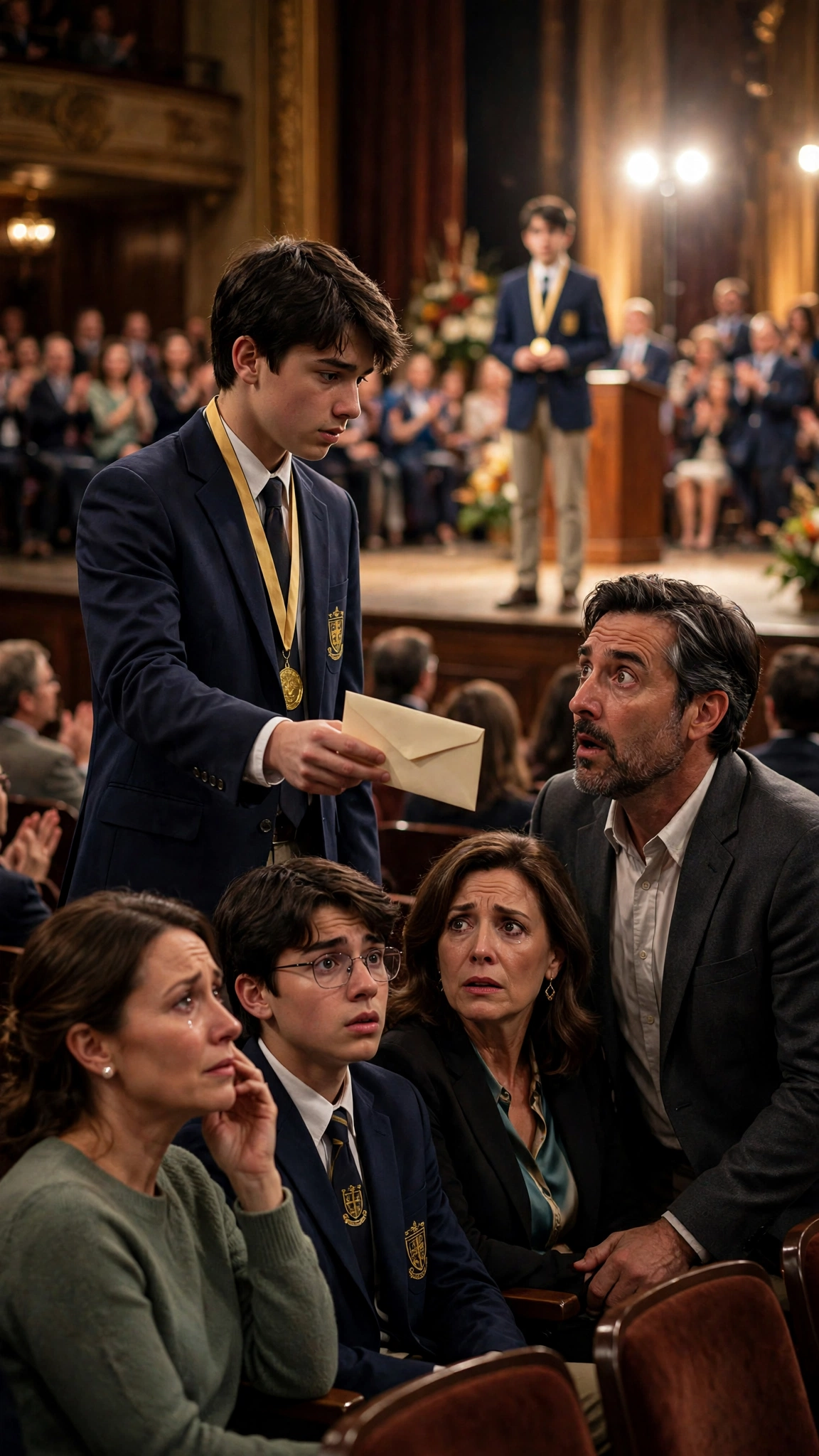
A father who walked away from his wife and twin sons thirteen years earlier experienced an unexpected confrontation with his past when he attended a statewide academic competition with his new family.
Stuart had arrived at the prestigious event to support the son he was raising with his former mistress, Simone. But when he unexpectedly encountered his ex-wife, Marianne Tate, he reacted with anger rather than curiosity.
What he failed to realize was that the two teenage boys standing nearby were his own sons.
Hours later, both young men would walk onto the stage to receive gold medals, and one would be recognized for achieving the highest raw score of any student in the state competition.
But the most emotional moment came after the ceremony, when one of the twins approached the father who had abandoned them and handed him an envelope they had been waiting thirteen years to deliver.
An Unexpected Reunion After Thirteen Years
Marianne Tate had spent thirteen years building a life without her former husband.
When Stuart left their marriage, their twin sons were still very young.
The separation forced Marianne to take on the responsibilities of raising two children without his presence.
Over the years, she became the parent who attended every school meeting, celebrated every birthday, helped with homework, and comforted the boys through difficult moments.
She witnessed their first major achievements and encouraged them through the disappointments that came with growing up.
While Stuart continued his life with Simone, Marianne devoted herself to ensuring that her sons had the stability and opportunities they deserved.
By the time the twins turned seventeen, they had developed into exceptionally talented students with a passion for academics.
Their dedication eventually earned them places at a statewide academic competition.
Marianne was excited to accompany them.
She had no reason to expect that the event would also bring her face-to-face with the man who had walked away from their family.
The Father Who Didn’t Recognize His Own Sons
The encounter occurred near the competition’s registration counter.
Marianne immediately recognized Stuart standing beside Simone.
Their son, dressed in an expensive private-school blazer, was preparing to participate in the event.
Thirteen years had passed since Marianne last stood face-to-face with her former husband.
For a moment, Stuart appeared stunned to see her.
Then his expression changed.
Instead of greeting her politely, he demanded to know why she was there.
Simone moved closer and suggested that the event was private.
Marianne calmly reminded them that it was a statewide competition.
But Stuart continued questioning her presence.
He appeared to believe that the day should revolve around the child he had come to support.
When Marianne explained that she was attending for her own children, Stuart laughed dismissively.
He looked toward the two teenage boys standing nearby.
But there was no indication that he recognized them.
The last photograph Stuart had seen of his twins had been taken during their christening.
Now they were seventeen-year-old young men.
He had missed almost their entire childhood.
He had no idea what they looked like, what subjects they enjoyed, or how much they had accomplished.
And as they stood only a few feet away, he failed to realize that he was looking at his own sons.
A Mother’s Quiet Decision to Walk Away
Marianne refused to turn the encounter into a public argument.
She knew that her sons had worked too hard to reach the competition for their day to be overshadowed by an uncomfortable confrontation.
She reminded the boys that registration would close shortly and guided them away.
But one of the twins had recognized the significance of the encounter.
As they walked toward the registration area, he quietly asked Marianne whether the man they had just met was their father.
She confirmed that he was.
The boy asked again, as though trying to make sense of what had happened.
Marianne answered honestly.
Neither twin said anything more.
For a mother who had spent thirteen years explaining their father’s absence, the silence was painful.
But she understood that the boys were old enough to form their own opinions.
She did not ask them to forgive Stuart.
She did not encourage them to confront him.
Instead, she allowed them to focus on the competition they had come to attend.
What she did not know was that her sons had something planned for later that afternoon.
Two Brothers, Two Gold Medals
At approximately four o’clock, the awards ceremony began.
Students, parents, teachers, and competition organizers gathered inside the auditorium to recognize the top performers.
The atmosphere was filled with anticipation.
Families waited to hear whether their children had earned recognition for months of preparation and hard work.
Marianne sat among the audience, hoping her sons would be proud of their performances regardless of the results.
Then the announcer reached the applied mathematics category.
One of her sons had won the gold medal.
Marianne could hardly contain her excitement.
She watched as her boy walked toward the stage to accept his award.
But the surprises were not over.
A short time later, the physical sciences category was announced.
Her other son had also earned gold.
Both Tate brothers had won first place in their respective categories.
Marianne was overwhelmed with pride.
For thirteen years, she had encouraged their curiosity, supported their education, and reminded them that hard work mattered.
Now she was watching both of her sons receive statewide recognition.
And then came one final announcement.
The Highest Score in the State Competition
The ceremony continued with recognition for exceptional overall performance.
When the announcer revealed the student who had achieved the highest raw score across the entire competition, Marianne heard her family’s name once more.
One of her sons had outperformed every other participant.
The achievement was remarkable.
The two brothers were already gold medalists, but now one had also received the event’s highest individual distinction.
As the auditorium applauded, Marianne watched her sons standing proudly onstage.
For her, the moment represented far more than medals or academic rankings.
It reflected years of dedication, late-night studying, school projects, and encouragement.
It was also a reminder of everything her children had achieved despite growing up without their father.
Several rows behind Marianne, Stuart was watching the ceremony.
And his expression was beginning to change.
The Moment Their Father Realized the Truth
At first, Stuart heard the surname Tate announced during the awards.
Then he heard it again.
He watched two teenage boys stand together.
Both had received gold medals.
As he looked more closely, he began recognizing familiar features.
One of the twins had his eyes.
His jawline.
Even the same expression when he smiled.
The resemblance became impossible for Stuart to ignore.
The boys he had failed to recognize at the registration counter were his own children.
For thirteen years, he had lived without knowing the details of their lives.
He had missed their birthdays, school events, important milestones, and everyday family moments.
Now they were standing onstage as two of the state’s most accomplished young students.
And he was discovering who they had become at the same time as everyone else in the auditorium.
A Conversation Stuart Was Never Meant to Hear
As the audience celebrated the winners, a man sitting near Stuart asked his wife about the two brothers.
The woman checked the program.
She recognized the Tate surname and mentioned that the twins had been raised by their mother alone.
Then she made a comment that Stuart could clearly hear.
She suggested that Marianne deserved recognition of her own for raising such accomplished children.
The words struck Stuart deeply.
That morning, he had questioned Marianne’s right to attend the competition.
He had treated her appearance as an unwelcome interruption.
Now he was hearing strangers praise her dedication as a mother.
The boys whose presence he had dismissed were among the event’s top performers.
And the child he had come to support had been outscored by one of the sons he had abandoned.
For the first time that day, Stuart seemed to understand the magnitude of what he had missed.
The Envelope That Changed the Celebration
After receiving his medal, one of the twins stepped down from the stage.
Marianne expected him to return to her.
But instead, the teenager turned toward Stuart.
He walked through the auditorium until he reached the row where his father was sitting.
Stuart slowly stood.
The boy stopped directly in front of him, his gold medal still hanging around his neck.
For a moment, father and son faced each other.
The encounter was extraordinary.
Thirteen years earlier, Stuart had left when his children were too young to understand what was happening.
Now one of those children was standing before him as a young man.
Then the teenager reached inside his jacket.
He removed an envelope.
His next words left Stuart with something far more important to consider than the awards ceremony.
The boy told his father that he and his brother had been waiting thirteen years to give him what was inside.
A Letter Thirteen Years in the Making
The fictional story ends before revealing the envelope’s contents.
It is not yet known whether the brothers had written a letter, preserved childhood memories, collected unanswered questions, or prepared something entirely different.
But the significance of the moment is clear.
The twins had not forgotten their father.
They had grown up knowing that he had chosen another life.
And despite his absence, they had become successful young men supported by their mother’s dedication.
For Marianne, the event was supposed to be a celebration of her sons’ academic achievements.
Instead, it also became an unexpected confrontation with a painful part of her past.
Stuart, meanwhile, was being forced to acknowledge a truth that no amount of regret could change.
He had missed thirteen years of his children’s lives.
He could not recover the birthdays, school performances, family dinners, or ordinary moments that had passed without him.
And although the boys had achieved extraordinary success, their accomplishments did not erase the emotional consequences of his absence.
The greatest question was no longer whether Stuart recognized his sons.
It was what they wanted him to understand now that he finally did.
As the seventeen-year-old stood before his father holding the mysterious envelope, the entire encounter came down to one unanswered question: What had two abandoned brothers been waiting thirteen years to tell the man who walked away from them?