

Arthur’s voice came from behind us.
“Helen. That’s enough.”
We both turned.
He was standing at the end of the hallway, still holding his phone — and for the first time since I’d met him, the charming, confident Arthur looked genuinely frightened.
Not of Helen.
Of losing me before he’d told me the truth.
“Please,” he said quietly. “Don’t go. Not yet. Let me show you something first. Then, if you still want to leave, I will drive you home myself and you will never hear from me again.”
Helen let go of my hand — slowly.
“Show her the photograph, Arthur,” she said. “The real one. It’s time.”
He led us into his study.
On the desk stood a framed black-and-white photograph I had never seen before. A young man — Arthur at twenty, with the same eyes — stood outside a Chicago diner beside a laughing young woman with dark curly hair.
And on that young woman’s upper lip, unmistakable even in black and white, was a dark, noticeable mustache.
She wore it with her head held high, grinning at the camera as if the whole world could look if it wanted to.
My legs gave way and I sat down.
“That’s my mother,” I whispered.
“Her name was Rose,” Arthur said. “Chicago, 1965. I was twenty years old, working nights at that diner, and she was the bravest person I had ever met. People teased her everywhere she went. She laughed at every single one of them. I fell in love with her in about four days.”
My mother had never — not once in her whole life — mentioned Arthur’s name to me.
But she had told me, when I was a teenager crying in front of a mirror about my own upper lip, one strange sentence I never understood:
“Baby, never be ashamed of that face. That face was loved once by a man who saw gold where other people saw a flaw.”
I thought she was just being kind.
She had been telling me the truth.
Arthur told me the rest. In the autumn of 1965, Rose’s family found out about the young man at the diner — a nobody, they said, with no money and no future. Within a week, they had packed up and left Chicago. No address. No goodbye. Arthur wrote to the diner’s owner for years. He saved for a ring he never got to give. Eventually, life went where life goes: he married a good woman, he was happy, he was widowed — and in all those years, he said, nobody could ever tell him what had become of Rose.
“Then, about a year ago,” he said, “a man I knew from the old neighborhood sent me her obituary. She passed in 2019. And in it, they mentioned her daughter.”
Me.
“I’m not proud of how I did this,” Arthur said. “I joined that dating app looking for you, with no plan except… I had something of hers. And a question I’d carried for sixty years. When I saw your photograph — her face, her eyes, looking back at me — I nearly dropped the phone. The close-up pictures I asked for… I was trying to be sure it was really you before I turned your life upside down. I kept telling myself I’d explain everything at dinner. Then you were sitting here, in her laugh, and I lost my nerve. I’m sorry. Truly.”
Helen spoke from the doorway, and now she was crying too.
“I dropped those glasses because I thought I was seeing a ghost. And I warned you because I was afraid he would keep his secret too long — and because, ma’am, a woman deserves to know why a man is looking at her the way he was looking at you. He isn’t a bad man. He’s just been carrying 1965 around for sixty years.”
Arthur opened a drawer and took out a small, worn box.
Inside was a gold locket.
“Your mother left this at the diner the last night I ever saw her. She ran back for her coat and it must have fallen. I’ve kept it safe for sixty years. There’s a photograph inside.”
My hands shook as I opened it.
Inside was a tiny photograph of Rose, young and smiling. And on the back of the locket, in engraving so small I had to hold it to the light, were three words:
“FOR MY DAUGHTER.”
“She came back for it a week after her family left Chicago,” Arthur said softly. “The owner mailed it to me with a note she’d left for me — in case I ever found you. She knew she was pregnant when they took her away. She knew she couldn’t come back. So she left this for the baby she hadn’t met yet — with the only man she trusted to keep looking.”
I held my mother’s locket against my chest and I cried like I was eighteen years old.
Then Arthur did something I will never forget.
He did not reach for me. He did not tell me our story had to mean anything. He simply sat down across from me and said:
“What happened between your mother and me belongs to 1965. It is not a debt you owe me, and I won’t have you pay it. I wanted you to have what was yours. If you walk out that door tonight, you’ll walk out knowing your mother loved you before she ever saw you — and that your face, this exact face, was once loved at first sight. That’s all.”
I looked at this man — this stranger who was not a stranger — and I understood everything at once.
Why he didn’t mind my facial hair.
Why he begged me never to hide it.
He wasn’t seeing past it. He was seeing my mother in it — and, somehow, he was also seeing me.
“I need time,” I said.
“Take sixty years if you need them,” he smiled sadly. “I’m patient. I’ve had practice.”
He drove me home in silence, like a gentleman. At my door, he didn’t ask for another date. He asked for one thing only:
“When you’re ready — if you’re ever ready — I’d like to hear about her life. The parts I missed. Only what you want to tell.”
It took me eleven days.
On the twelfth, I put on my purple floral dress, I did not touch my upper lip, and I walked to his porch with two coffees and sixty years of my mother’s life to tell.
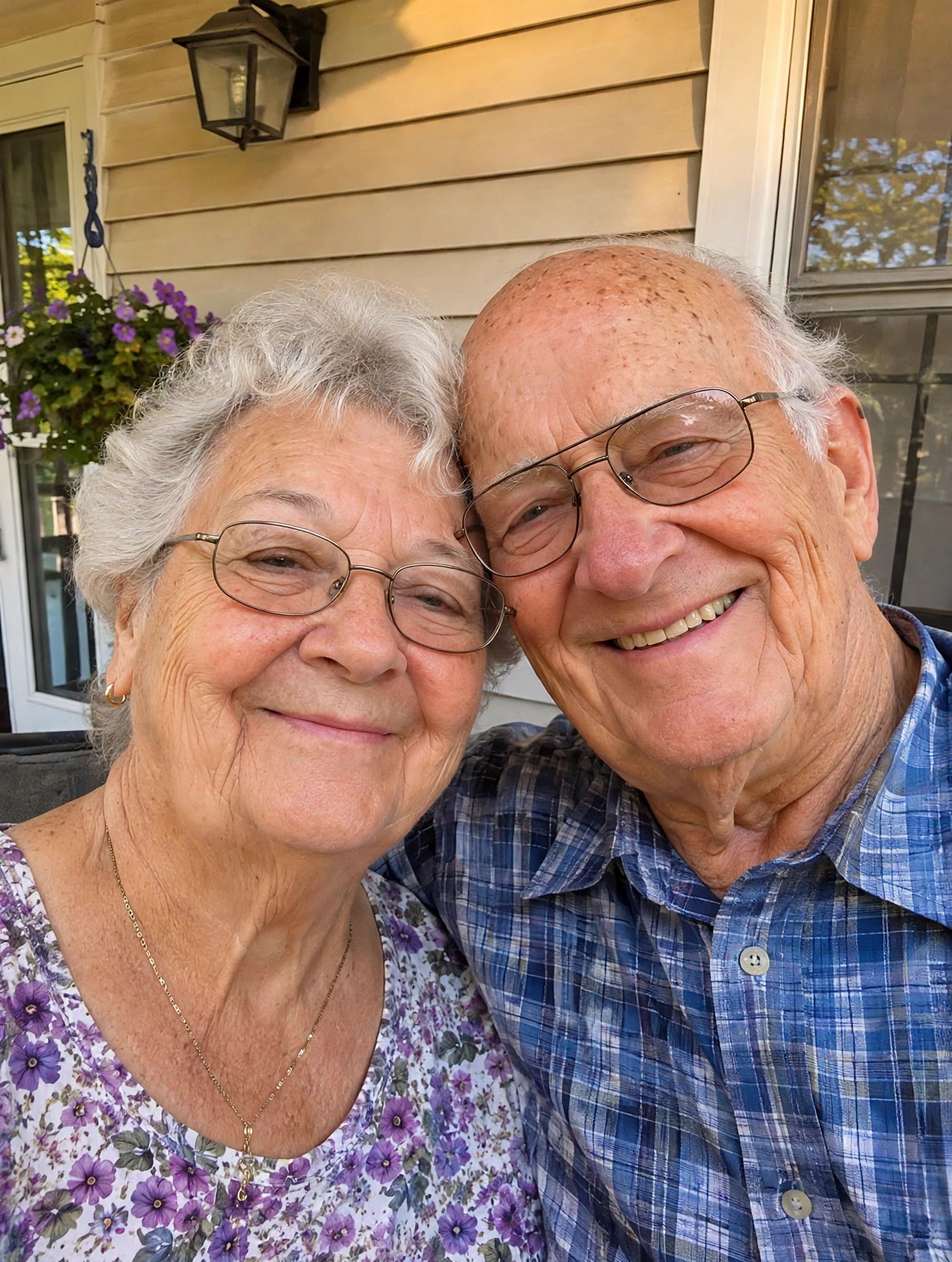
We are not young lovers, Arthur and I. We are two old people who found, at the very end of everything, a door back into a room we both thought was locked forever. Some afternoons we talk about Rose. Some afternoons we talk about us. And some afternoons we just sit on that porch, cheek to cheek, saying nothing at all.
And as for the locket — I wear it every day now.
On the front, my mother’s face.
And inside my heart, her words, sixty years in the mail:
Never be ashamed of that face.
That face was loved once.
And now — at seventy-eight years old — it is loved again.
— END —
Did Arthur do the right thing by looking for her — or should some doors stay closed? Tell us in the comments, and share this story with someone who has ever felt ashamed of the mirror. ❤️