

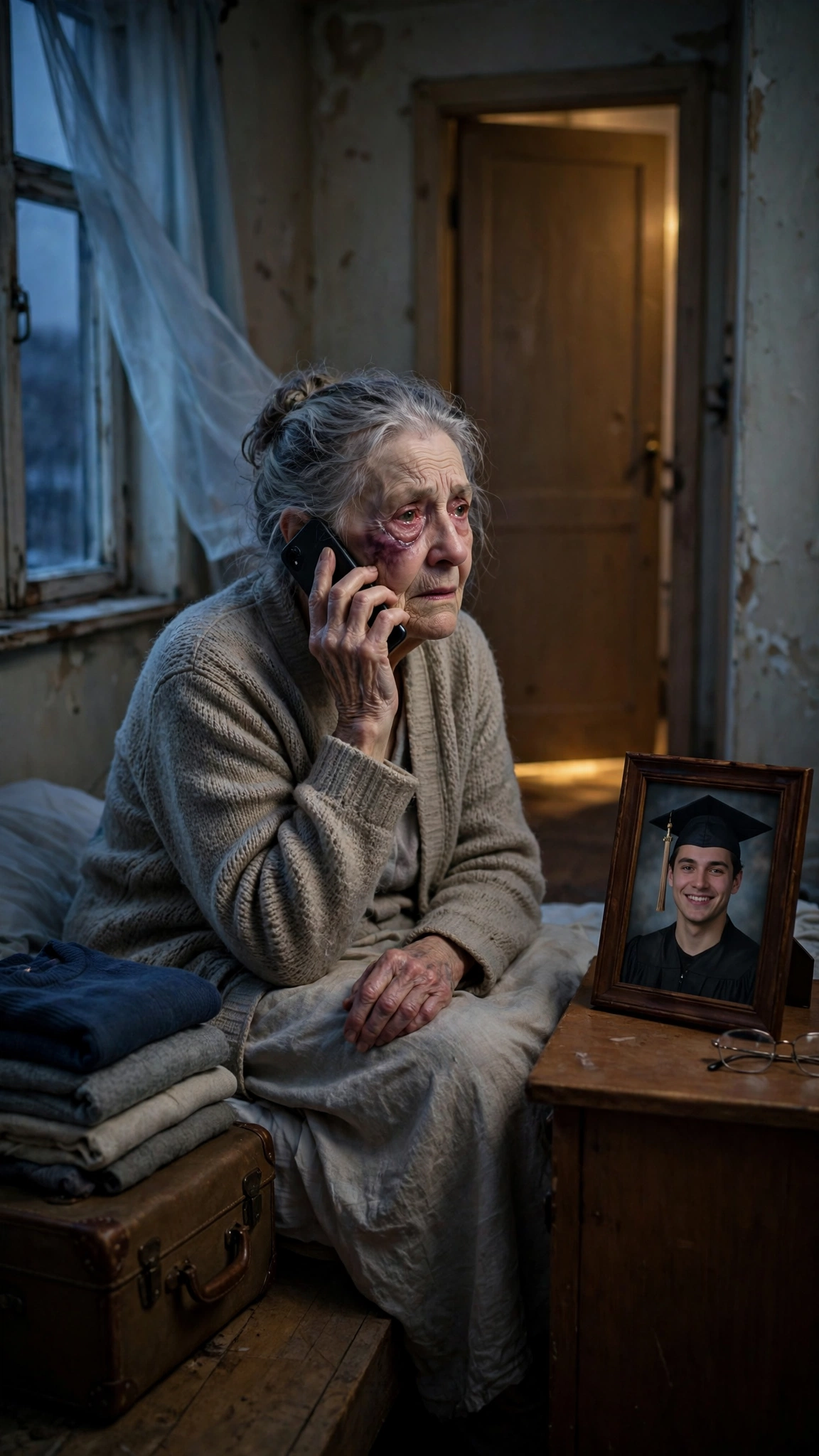
A 73-year-old mother who spent decades sacrificing everything to raise her only son faced a heartbreaking betrayal when he struck her for politely asking his wife not to smoke inside their home.
The elderly woman, who suffered from damaged lungs and struggled to breathe around cigarette smoke, had moved into her son’s luxurious Scottsdale, Arizona, home believing she would finally enjoy a peaceful retirement.
Instead, she found herself living in a small, uncomfortable guest room, contributing money toward household expenses, and enduring increasingly disrespectful treatment.
But just fifteen minutes after her son slapped her and left for dinner with his wife, she made three telephone calls that could change all their lives.
And when unexpected visitors arrived the following morning, her son began to realize that his mother was no longer willing to remain silent.
A Simple Request That Ended in Violence
Bernadette, 73, had never imagined that asking someone to stop smoking near her would result in an act of violence.
That afternoon, she was standing in the kitchen of her son’s Scottsdale home when she noticed her daughter-in-law, Brielle, smoking a cigarette.
Because Bernadette had serious respiratory problems, cigarette smoke made breathing particularly difficult.
She politely asked Brielle whether she could avoid smoking inside the kitchen.
She did not raise her voice or make accusations.
She simply wanted to protect her health.
But before she could finish explaining, her son approached and struck her across the face with an open hand.
The impact caused her head to jerk sideways.
She grabbed the marble countertop to keep herself from falling.
Her cheek burned, and her heart began racing.
What devastated Bernadette most was her son’s reaction afterward.
He showed no visible remorse.
Instead, he told his mother that the slap should teach her to remain quiet.
Brielle continued smoking.
Moments later, Bernadette’s son kissed his wife on the forehead and suggested they go out for dinner.
The couple left the kitchen as though nothing unusual had happened.
Bernadette remained standing beside the countertop, struggling to understand how the child she had raised had become capable of treating her this way.
A Lifetime of Sacrifice for Her Only Son
Bernadette had raised her son alone in Columbus, Ohio.
Their early years were filled with financial hardship.
She worked multiple jobs to afford rent, utilities, groceries, and the everyday expenses of raising a child.
There were periods when she held three jobs simultaneously.
She often sacrificed her own comfort to ensure her son had everything he needed.
When he struggled, she supported him.
When he succeeded, she celebrated.
One of her proudest memories was watching him graduate.
She still kept a photograph of the occasion.
In it, her son wore his graduation gown while Bernadette embraced him, smiling proudly.
For her, that photograph represented the sacrifices that had made his success possible.
She had believed that the love and care she gave him would create a bond that lasted throughout their lives.
But decades later, their relationship had become painfully different.
A Promised Retirement That Became a Nightmare
Six months before the incident, Bernadette had moved from Ohio to Arizona.
Her son had invited her to live with him and Brielle in their spacious Scottsdale residence.
He told her that the arrangement would be better for her health.
He promised she would have companionship, security, and a comfortable home.
Bernadette accepted because she trusted him.
At seventy-three, she hoped she could finally stop worrying about the practical difficulties of living alone.
But the conditions were not what she expected.
Despite the size and luxury of the property, she was assigned a small guest room that felt cold and unwelcoming.
The window did not close properly.
The bathroom was cramped.
Her personal belongings were confined to a small area, making it difficult for her to feel that the space was truly hers.
Bernadette also contributed money toward household expenses every month.
In addition, she helped with cleaning and other chores.
She rarely complained.
She convinced herself that if she remained patient and grateful, her son and daughter-in-law would eventually treat her with more kindness.
But the situation continued to deteriorate.
Her Damaged Lungs Made the Smoke Dangerous
Bernadette’s health concerns were not minor inconveniences.
Years of working in dusty factory environments had damaged her lungs.
Her doctor had explained that exposure to irritating substances could worsen her breathing difficulties.
For that reason, asking Brielle not to smoke in the kitchen was a reasonable health precaution.
Yet her son treated the request as an act of disrespect.
After the slap, Bernadette was left alone with a swollen cheek, shallow breathing, and the lingering smell of cigarette smoke.
She heard the couple laughing as they left the house.
Then her son’s truck drove away.
For fifteen minutes, she remained alone.
Finally, she walked into her bedroom and sat down beside the graduation photograph.
She stared at the image of the young man she had once embraced so proudly.
She remembered how he had hugged her, cried with happiness, and thanked her for helping him reach that milestone.
Now the same son had struck her for asking to breathe clean air.
The contrast was almost impossible to comprehend.
Three People She Had Helped Years Earlier
As Bernadette sat in her bedroom, she began remembering people whose lives she had touched over the years.
Although she had spent much of her life supporting her son, she had also helped others who were not related to her.
One was a young boy who had needed somewhere safe to sleep.
Another was a girl whose mother Bernadette cared for, allowing the young woman to complete her education.
The third was a college student who frequently shared meals at Bernadette’s table because he struggled to afford food.
Years had passed.
All three had grown into successful adults.
The boy was now Gregory, an attorney.
The young woman was Tessa, a journalist.
And the former college student was Raymond, who worked investigating financial transactions.
Bernadette had never helped them because she expected repayment.
She had offered kindness because she believed people should support one another during difficult times.
But now, when she needed help herself, she remembered that she still had their telephone numbers.
The First Phone Call
With trembling fingers, Bernadette called Gregory.
He answered warmly, pleased to hear from someone who had helped him during his younger years.
Then he asked whether she was doing well.
Bernadette almost gave the answer she had repeated for months.
She nearly told him that everything was fine.
But when she touched her swollen cheek, she realized she could no longer pretend.
She admitted that she was not all right.
She told Gregory she needed help.
His tone immediately became serious.
He asked where she was and what had happened.
Bernadette explained enough for him to understand that she was frightened and had been physically assaulted.
After speaking with Gregory, she called Tessa.
Then she contacted Raymond.
By the time she finished all three conversations, Bernadette was still shaken.
But something important had changed.
For the first time in months, she no longer felt completely alone.
Six Months of Photographs Became Important
That evening, Bernadette’s son and Brielle returned from dinner.
They appeared cheerful and relaxed.
Neither made any attempt to address what had happened earlier.
Bernadette stayed in her bedroom.
She began reviewing photographs she had taken during the six months she lived in their house.
Some showed the damaged window in her guest room.
Others documented the cramped bathroom and limited space provided for her belongings.
She also had receipts showing money she had contributed toward household expenses.
Until that night, the photographs had simply reminded her of the circumstances she had been enduring.
Now she realized they might help explain her living conditions to someone who could assist her.
They did not automatically establish wrongdoing, but they provided a record that could be examined alongside her account.
Bernadette also understood the importance of documenting the injury to her face.
The following morning, she woke to discover a dark bruise forming on her cheek.
She photographed it.
Then she got dressed.
She chose a cardigan her son had given her many years earlier, during a happier period in their relationship.
Despite everything that had happened, she still remembered the child he used to be.
An Unexpected Visit at Nine O’Clock
The following morning, Bernadette walked into the kitchen.
Her son was looking at his phone.
Brielle was eating yogurt.
Neither asked about the bruise on Bernadette’s face.
Neither offered an apology.
Bernadette quietly prepared a cup of coffee and sat down.
She did not start an argument.
She did not threaten anyone.
Instead, she waited.
At exactly nine o’clock, the doorbell rang.
Her son looked up, irritated by the interruption.
He asked whether she was expecting someone.
Bernadette calmly set her coffee cup on the table.
She told him that she had invited visitors.
Then the doorbell rang again.
And for the first time, her son’s expression began to change.
A Mother Who Finally Refused to Remain Silent
The fictional story ends before revealing exactly who arrived at Bernadette’s home or what happened after the doorbell rang.
However, the three telephone calls she made the previous evening suggest that she had begun seeking outside support rather than continuing to face her situation alone.
Gregory’s legal experience, Tessa’s journalism background, and Raymond’s investigative skills could each become relevant as the story develops.
The extent of their involvement remains unknown.
What is certain is that Bernadette had reached a turning point.
For years, she had dedicated herself to helping others.
She had worked multiple jobs to support her son, provided assistance to young people facing hardship, and continued contributing financially even after moving into her son’s home.
But at seventy-three, she was being forced to confront a painful reality.
The person she had spent her life protecting had become the person she feared.
As the doorbell rang for a second time, Bernadette sat calmly at the kitchen table.
Her son had left her alone the previous evening, believing that a slap and a warning would be enough to silence her.
What he did not realize was that the three people his mother had helped years earlier were no longer helpless young people—and Bernadette had finally asked them for help.